Tips · PUTTING · SPEED · DOWN THE LINE
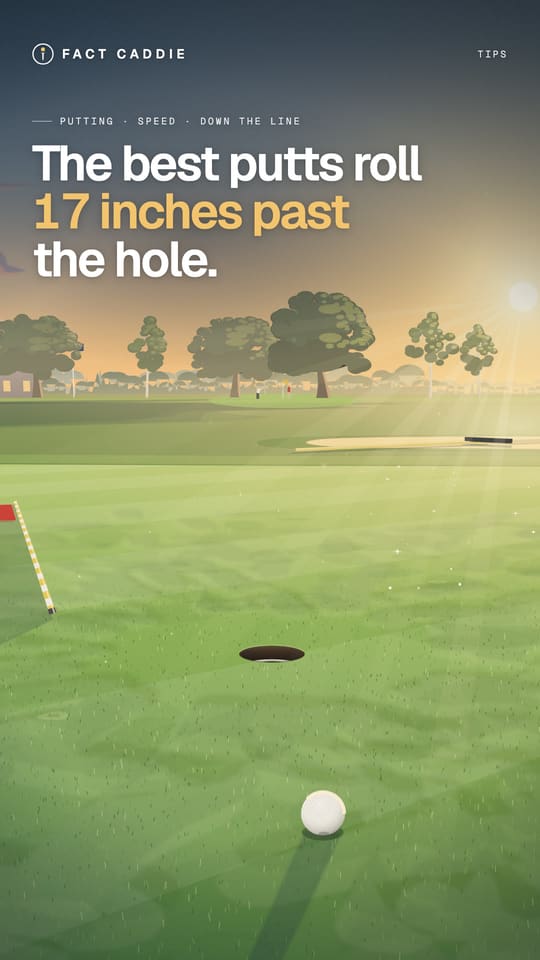
The best putts roll 17 inches past the hole.
Dave Pelz, a NASA scientist turned short-game researcher, found the best speed for a putt is the one that would roll it about 17 inches past the hole. Slower putts get knocked off line by the lumpy doughnut of footprints round the cup; faster ones lip out.
The one to remember
Pelz's optimum: firm enough to finish about 17 inches past if it misses.
Facts and sources
- Dave Pelz advised rolling putts to finish 17 inches past the hole when they miss: "Research proves that putts have a greater chance of finding the cup (regardless of putt length) when the ball rolls at this speed" (GOLF Magazine, 2006). His institute dates the finding to 1991.
- Pelz joined NASA's Goddard Space Flight Center in 1961, rose to senior scientist and left in 1975 for golf; in 1976 he built a device to roll perfect putts. He died in March 2025, aged 85 (The New York Times; pelzgolf.com).
- In Pelz's words, the lumpy doughnut is the congregation of footprints within six feet of the hole, and the last 12 inches are almost footprint free. A foursome leaves more than 500 footprints on a green, which take up to two hours to spring back (GOLF.com, 2021).
- Physics: Brian Holmes showed in 1991 (American Journal of Physics) that a ball must reach the hole at no more than about 1.63 metres a second, about 3.6 miles an hour, to be captured. A 2025 analysis by Hogan and Antali shows a ball arriving near the edge of the hole can lip out at under half that speed.
- TrackMan's figures for a flat green running about 10 on the Stimpmeter: a putt fast enough to finish one and a half feet past meets a hole about 25 percent smaller in effect, and one fast enough to finish about five feet past, 63 percent smaller (GOLF.com, 2020).
Illustration: the green and the course round it, the golfers and their footprints, the ring they make, the putts, the practice green with Pelz's kit, the testing machine (drawn after his ramp that rolls a putt, not to its design) and the small figure of Pelz are drawn to explain, not recorded; the putts slow down as on a green of about 10 on the Stimpmeter, the dying putt's jinks are drawn to show the effect, the lip-out is shown in slow motion, and the gold circle in the cup shrinks to 37 percent of its width, TrackMan's figure for a putt that would finish five feet past.
Sources
- 10 brilliant short-game tips from teaching legend Dave Pelz · GOLF.com, Zephyr Melton (26 March 2025), Pelz's tips from GOLF Magazine, August 2006 checked 11 October 2026
- A Tribute to Dave Pelz (1939–2025): milestones · Pelz Golf (pelzgolf.com) checked 11 October 2026
- Dave Pelz, scientist turned golf instructor, is dead at 85 · The New York Times (5 April 2025), read in The Boston Globe's syndicated copy checked 11 October 2026
- There's a scientific reason why you're missing putts, and it's not your fault · GOLF.com, Luke Kerr-Dineen (24 March 2021) checked 11 October 2026
- 5 research-based tips from a legendary short-game guru, remember them · Golf Digest, in Australian Golf Digest's copy of the golfdigest.com article (29 March 2025) checked 11 October 2026
- Mechanics of the golf lip out (with its review of B. W. Holmes, Putting: how a golf ball and hole interact, Am. J. Phys. 59, 129–136, 1991) · Royal Society Open Science 12: 250907, S. John Hogan and Máté Antali (5 November 2025), open access checked 11 October 2026
- The physics behind the 'lip out' phenomenon in golf · University of Bristol news (5 November 2025) checked 11 October 2026
- Physics of golf · Rod Cross, School of Physics, University of Sydney checked 11 October 2026
- How to make the golf hole bigger when you putt, according to science · GOLF.com, Luke Kerr-Dineen (16 April 2020), with TrackMan's data checked 11 October 2026
The narration is AI-generated. Sources last checked 11 October 2026.
Script
The best speed for a putt would roll it about 17 inches past the hole. That number came from Dave Pelz. After nearly 15 years as a scientist at NASA, he spent decades testing putts with machines. Golfers walk all around the hole but seldom within a foot of it. Their footprints leave a ring of bumpy, trampled turf around the cup, out to about six feet. Pelz called it the lumpy doughnut. A dying putt wobbles over those bumps and gets knocked off line. Hit too hard, and the hole gets smaller. A fast ball has to catch the middle of the cup, or it lips out. Hit to roll 17 inches past, putts of any length had the best chance of dropping. Follow Fact Caddie for more.